


PERFORMANCES: NEW AND OLD
Hello All!
I apologize for the hiatus. I have been swamped with work, recovering from a back injury and have neglected admin. There is so much I need to update you on!
I will start with what is NEW
TOMORROW 2.09.2026

The event begins with a lecture by the incredibly talented River Roux. Roux’s lecture is based on her research for the performance ‚JUICE‘, tracing back the complex history of inter*people undressing in backrooms, for so-called medical training or as part of exhibitions. Using archival material from 1700-1920 she tells the story of the medical communities‘ obsession with the intersex body and the means of inter*individuals to turn this obsession into possibilities for independence from a binary world.

A young woman in pain enters a doctor‘s office. She leaves that office a man, seeks out another doctor in another office, leaves it a woman again, seeks out another doctor in another office, leaves that office a ‚hermaphrodite‘. Her visits take place during a century that defined ‚sex‘ as we believe to know it. One doctor after another records her visits in great detail, none of them takes her pain. Their records are used to fuel a drawn out fight over the existence of inter*people and an insatiable interest for their perceived deceptiveness. Louise, her doctor’s claim, undresses professionally, as many of those that became subject to medical record.
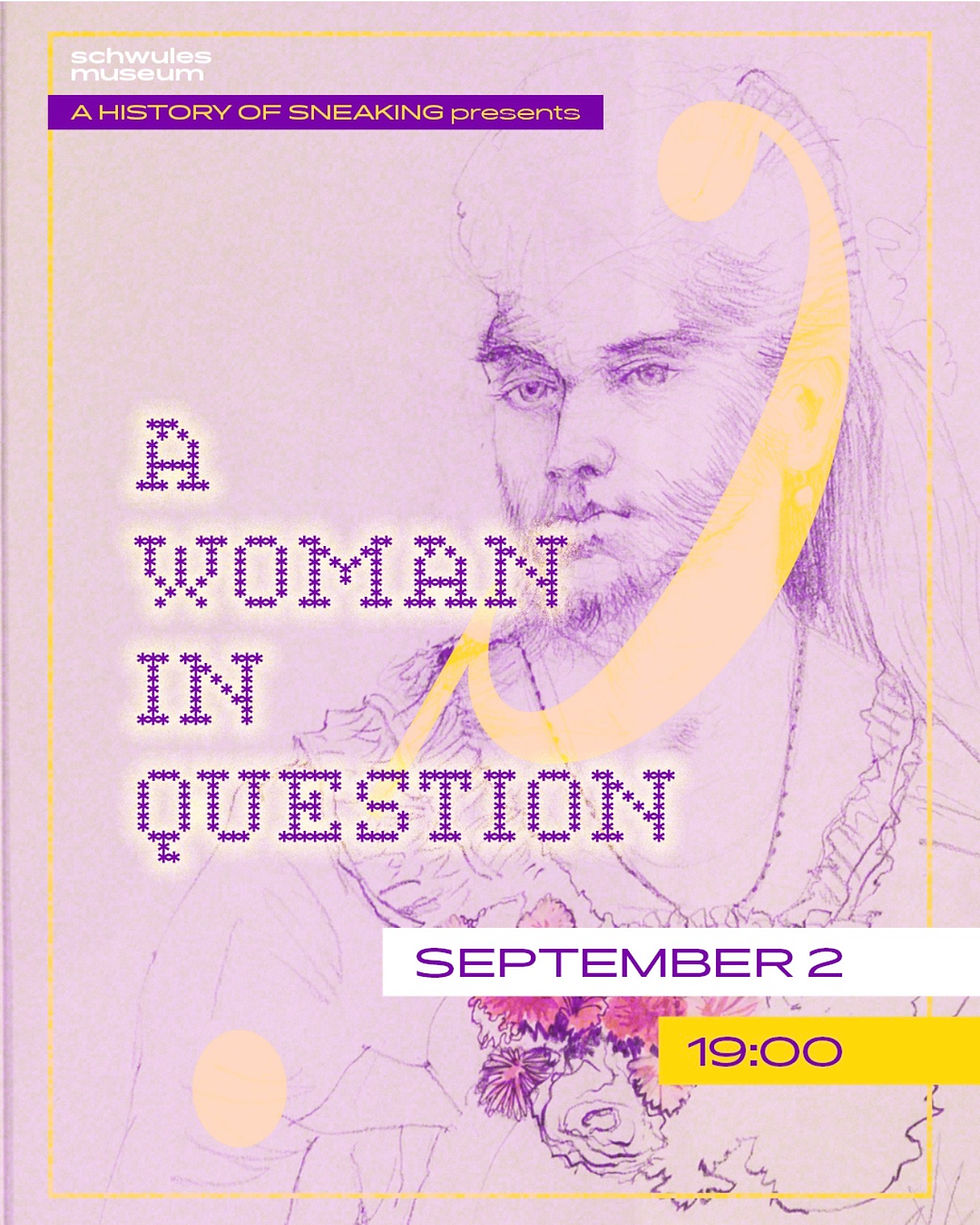
Multidisciplinary artists River Roux and Adrian Marie Blount both base their work on the intersection of archive, performance, and the body; using historical research, drag, and movement to unsettle the categories medicine and society impose on gender and sex. In A Woman in Question, they bring Louise’s buried case back into the light, asking who gets to define a body, and at what cost.
An event in spoken English with free admission!
Performance von Sarah Ama Duah: To Build to Bury To Remember
Hamburger Kunsthalle 4.09.2026 16 uhr -17:30

photo by Sara Estio
I recently had the honor of participating in this performance at the Minsk Museum on 29/30 August 2026. The experience was absolutely phenomenal. The power of embodying monument in prestigous space as an androgynous black queer was world bending. I love bending worlds.
In To Build, To Bury, To Remember, artist Sarah Ama Duah creates a performative installation that bridges sculpture and the body. At Hamburger Kunsthalle, she collaborates with four performers to construct living latex monuments that emerge from her exploration of historical monuments and their contemporary potential. . The performance is a Kampnagel production in collaboration with Crossing Currents – Hamburg Art Week and the Hamburger Kunsthalle.
Meeting place: Rotunde
Admission: Free; no ticket required
Duration: 90 minutes
Performers: Adrian Blount, Naomi Boima, Sarah Ama Duah, Rositsa Mahdi, Maleburu Moorosi
Now to get into the OLD
Performance von Magda Korsinsky
In German, English and French with German and English subtitles

„I always wanted to find a family I fitted into. Perhaps it is necessary to create one myself.“
There are hardly any models for us to draw on. What our parents or caregivers lived and showed us cannot simply be carried over into our own lives. Their worlds were different, as were their patterns of relating. We are finding our own ways of recognizing our needs, expressing them, and following them. As Black and queer people with caregiving responsibilities for children, we are searching for something that does not yet exist.

Three performers move within a space created specifically for the production, taking visitors into their world. The starting point is interviews that Magda Korsinsky conducted with Black and queer people about questions of inherited gender roles and personal childhood experiences, economic pressures and structural injustice, love and anger, shared responsibility, and healing relationship models. The performers weave lived experience together with movement, rap and song until a shared space emerges: one of diverse responsibility, intimacy, care, love and resistant forms of living together.

In Arrival of the Village, documentary choreographer Magda Korsinsky and her team set out in search of transformed relationships — because the old model of the heteronormative nuclear family produces roles that often isolate, exhaust or create dependency. Recognition, desire, self-determination and equality fall by the wayside. And how can one be a role model when so much feels wrong? How can we expand our notions of family and live out collective care, shared responsibility and mutual empowerment?

Arrival of the Village is Magda Korsinsky’s fifth work at Ballhaus Naunynstraße, continuing her search for role models, spaces and narratives for Black FLINTA*.

The work is a further step towards an art that creates spaces of resonance and sets its own rhythm against the harshness of dominant discourses.
Stay Tuned for more performances!
by Bibiana Mendes, River Roux
This one is not for kids! 18+ is recommended.

Photo by Rosa Merk
March 1988, 10:30 p.m., psychiatric clinic of Charité in East-Berlin: A young woman holds a syringe to a nurse’s neck. „I am a woman, don‘t you think?“, she’d asked on her first day on the ward. Now, three police men and a doctor gather outside her door. The doctor did not document her answer. Neither did she document if the young woman with the syringe is out for revenge or attempts resistance, if she seeks vengeance, chaos, or the answer to her question.

photo by Luna Zscharnt
Rage is involuntary. It is able to consume the one who feels it and alienate the one who does not. Rage is a symptom of rupture, the result of a breakage. In rage, we come undone. Resulting from the will to keep living, to change adverse circumstances, rage is akin to desire. When rage chains us to one another, it creates a movement. In prick, prick, boom, four performers invoke bodies beyond reason. They stop to duck, to evade, to apologise for a dream of militancy and rage without consequence. Berlin is a historical site of criminalization and eradication of queer life, of the obstruction of queer collectivity. Records of disobedience are found in archives, between the lines of discharge reports, arrest records, and newspaper clippings.

Photo by Rosa Merk
Lou Thabart, Paula Pau, Adrian Marie Blount and River Roux practice derailment as resistance. Handbags become tools of defence, high heels turn into projectiles, braids into whips. To stay calm is not an option and patience is a scarce resource. „I have done all the pleading I can; demanding I can’t,“ the young woman wrote on the ward. What’s beyond the plea?
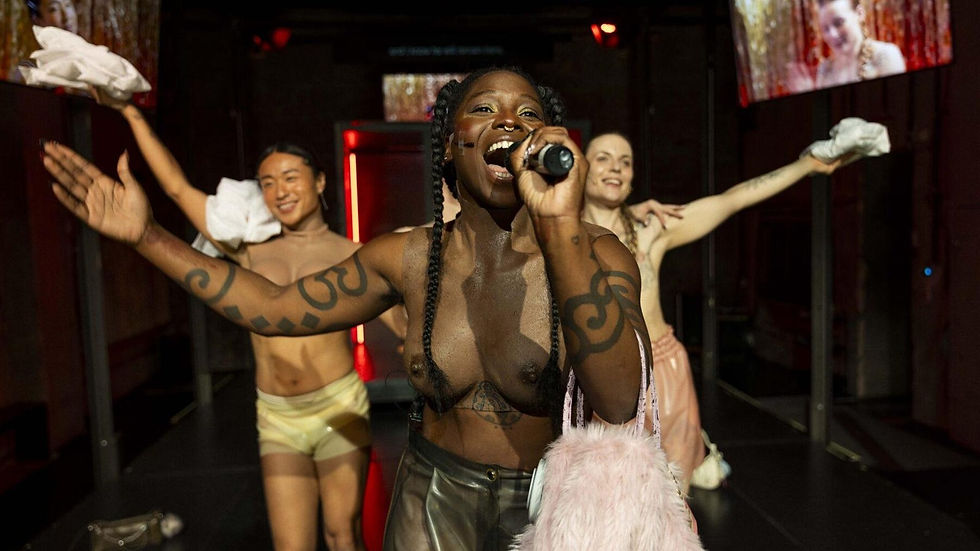
photo by Luna Zscharnt


Comments